.svg)




Six Years. One Platform. One Team Built for Rail.
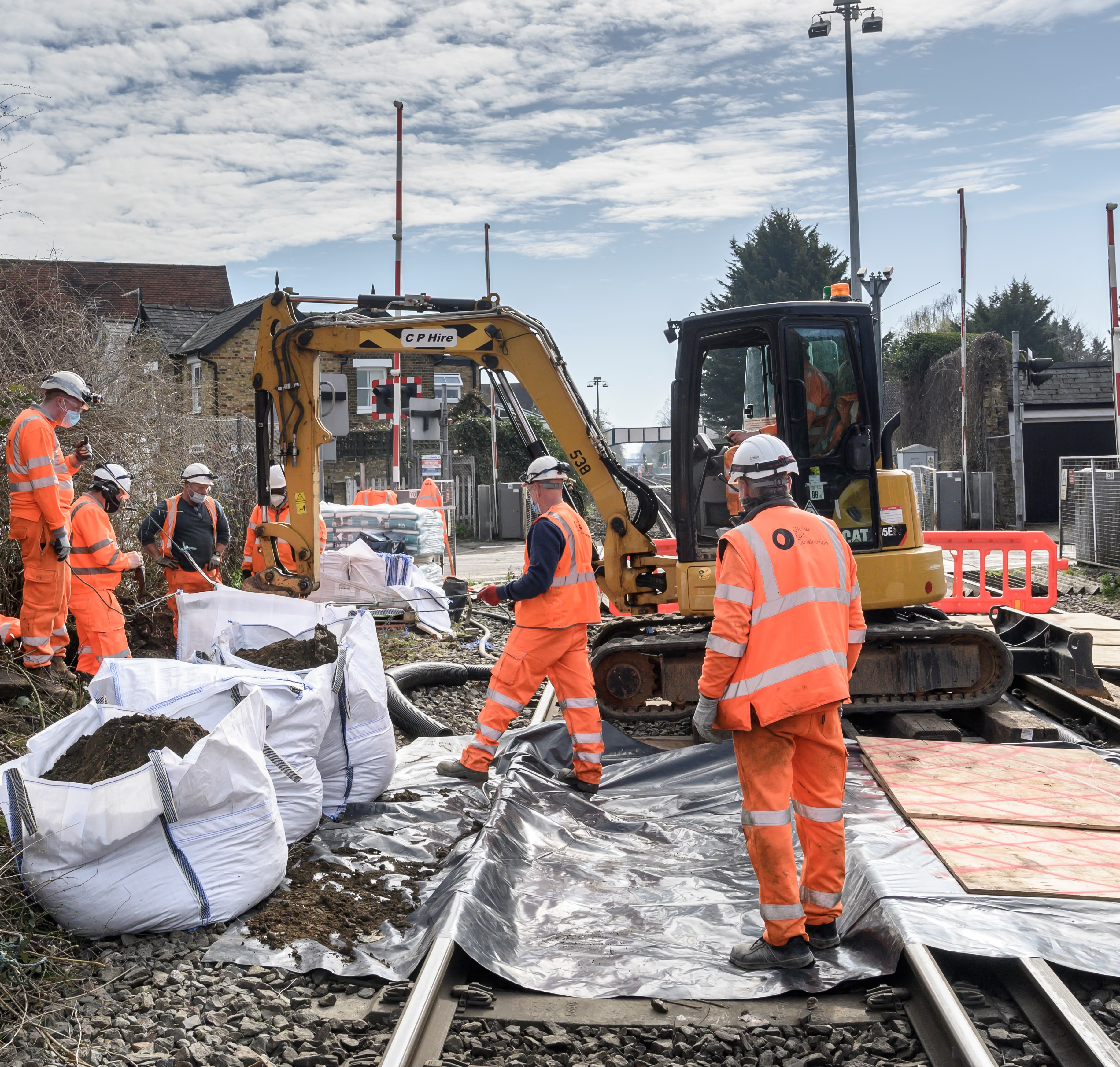
GRCL turns 25 this year. Since 2001, the team has taken on some of the most technically complex, multi-disciplined contracts on the UK rail network. As principal contractor, GRCL has delivered high-profile schemes across both Transport for London and Network Rail infrastructure.
The business operates nationwide, with teams spread across the North of England, the Midlands and the South of England, often working through nights and weekends to deliver critical works within tight possession windows. Just over two years ago, GRCL became part of the RSK Group, opening doors into new sectors like water while continuing to grow its rail portfolio. Today, with works underway on projects including the Sizewell C nuclear power station, where GRCL is the signalling installation contractor on behalf of Atkins Realis, the business is operating at serious scale.
And all of it runs on innDex.
Marco Lombardelli, Managing Director at GRCL and Co-founder of the Global Infrastructure Group, has been at the heart of that growth, and at the heart of the decision to build innDex into the way the business operates.
Nationwide Teams: The Problem with Paper.
Before innDex, GRCL faced a challenge that will be familiar to anyone who has managed a nationwide construction or infrastructure workforce: the records were always somewhere else.
Teams out in the field completed paperwork at the end of a shift, and then that paperwork had to find its way back to the office. Sometimes it arrived two weeks later. Sometimes information was missing. Sometimes the photos that were supposed to accompany a daily record sheet turned up separately, or not at all. And by the time everything finally landed, an application for payment had already gone out, without the supporting evidence that clients expected to see.
"When it was a document that we had to complete, you very rarely got the photos," says Marco. "It was sent separately, and then someone had to correlate the two together. You could be waiting ten days, two weeks, and by the time the paperwork came in, the application had already been submitted."
The same challenge ran through everything: inductions, risk assessments, close call reports, timesheets. For a business working nationwide, getting consistent and timely records back from site on a paper-based system was simply an uphill battle.
So GRCL went looking for something better and smarter.
Small Start, Big Impact.
The introduction to innDex came through a mutual contact. GRCL who had previously worked as a subcontractor to Volker Fitzpatrick, was put in touch with innDex co-founder Aaron Vousden at a time when both sides were at the beginning of a journey. GRCL needed a digital platform. innDex was in its early stages and looking for partners who could help shape what it would become.
"The timing was absolutely perfect for both parties," Marco says.
GRCL began with a trial on a single, smaller project, then scaled to a larger project prior to rolling innDex out across the entire business. From the beginning, the relationship was collaborative. Regular meetings, a shared hit list of priorities, and an agreed timeline for development meant that GRCL and innDex were building something together rather than simply buying and implementing off the shelf. Over the years, that ongoing dialogue has shaped the platform itself.
"A lot of what we have on innDex now has come through our own requests, to be perfectly honest," Marco says. "Tools and processes that are specific to how we operate as a business. A lot of it has evolved through the regular dialogue we have with the innDex team."
The first tools to go live were the ones where the pain was sharpest: sign-in, sign-out, inductions, and geofenced mobile clocking. From there, the platform grew steadily into something that now touches almost every part of how GRCL operates.
Daily Diaries: Evidence That Speaks for Itself.
For a business like GRCL, where monthly applications for payment must be supported by clear, accurate records, the Daily Diaries tool has become one of the most critical parts of the platform.
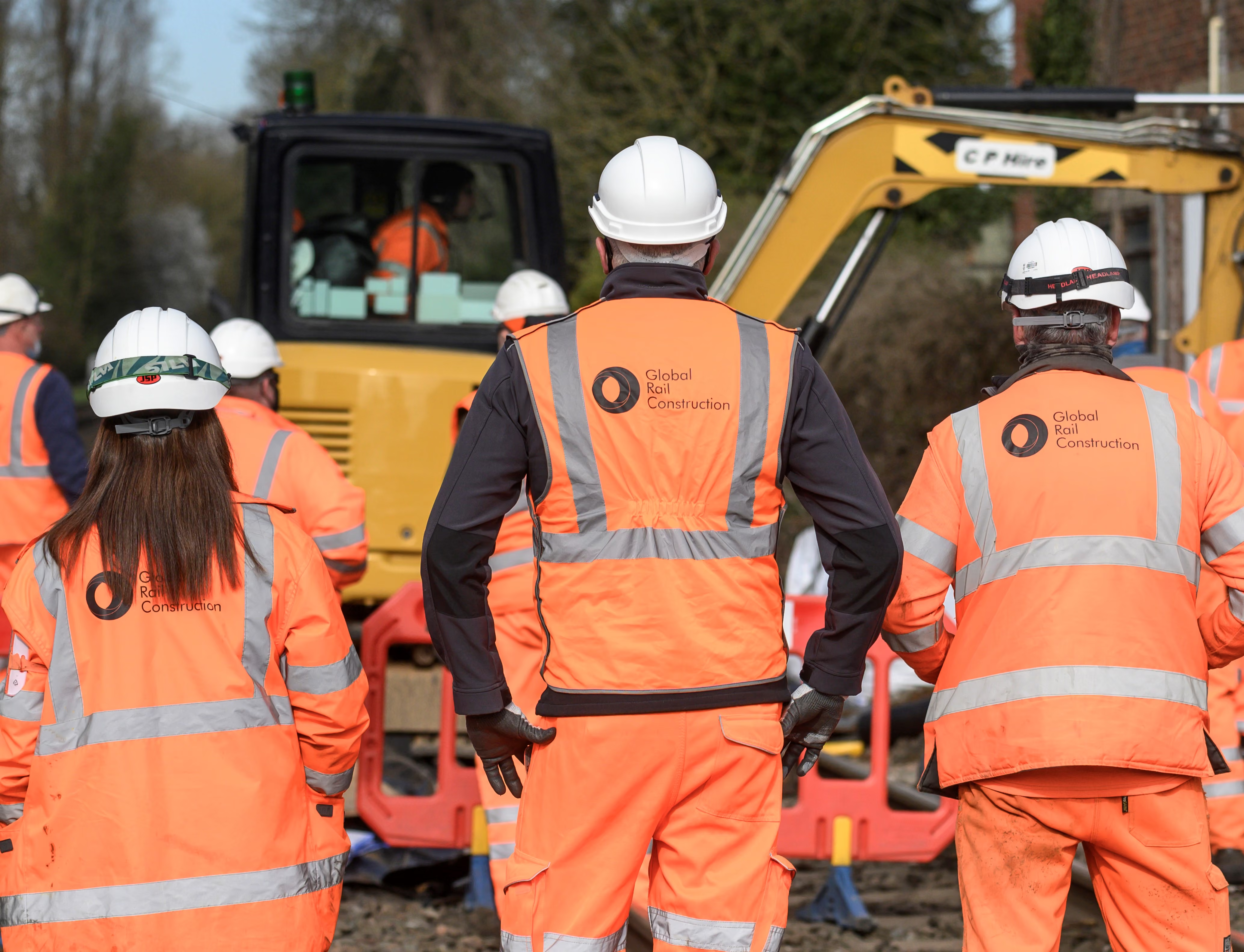
Every team completes a daily record sheet at the end of each shift. If a team moves between jobs on the same day, they complete one record per activity. Each entry logs the work undertaken by the workforce involved, the plant used, the materials consumed, progress against the plan, and pre and post work photos taken on site.
Before innDex, photos and records arrived separately, if they arrived at all. Now they are submitted together, in real time, and reviewed by project managers the same day.
"Not only do we need the detail in those daily record sheets to be accurate, but the photos that accompany those activities also give credence to what we do and that the work is actually completed," Marco explains. "We can share that with our clients on a daily basis. When it was a paper document, you very rarely received the photos, and it was an absolute headache tying the two together."
The result is reporting that we and our clients can trust, and a commercial record that holds up under scrutiny. "Our reporting is so much more accurate, so much more detailed," Marco says. "It's transformed our business."
Close Calls: From the Black Hole to Real Change
GRCL has long been committed to close call and good call reporting, a practice that asks workers to flag near misses and unsafe conditions before they become incidents. The challenge, as with so much else, was getting that culture to actually work on paper.
"In the past, you'd fill a card in or an A4 piece of paper. There's a reluctance because there's effort involved, so many close calls simply weren't being reported. And where they were, feedback was rare. Once it went into the black hole, it stayed there."
Digitalising close call and good call reporting on innDex changed that. Reports are submitted from a phone, tablet or laptop in minutes. Managers can review and respond. Records are shared with clients. The QSE team meets regularly with their client counterparts to go through the data and close actions out accordingly.
"That ability to review it regularly, and for our people to get updates far more consistently than before, encourages them to stay part of the process. And if we keep raising close calls and good calls, we're keeping our environment and our people safe. That's the key objective."
GRCL took it a step further. The business set a target of 1,000 close calls and good calls in a calendar year, with a pledge to donate double that number in pounds to a local charity, if the team hit the target. Last year, they exceeded 1,000. A donation of £2,000 was made, and thanks to the government's Big Give scheme, which matched it, the charity received £4,000.
"That demonstrates our commitment, but it also keeps people motivated because they can see others are benefiting from those reports," Marco says.
Fatigue Management: Control When It Matters Most
Rail work demands a lot from people. Major commissioning weekends mean back-to-back shifts, and GRCL has a legal and moral obligation to ensure its teams have proper rest periods built in around those works.
Before innDex, managing fatigue compliance meant project managers completing Excel spreadsheets and submitting them for review and approval, sometimes at the last minute. Now, with fatigue management running on innDex, the process is digital, visible in real time, and far less stressful for everyone involved.
"It was effectively a paper exercise, an Excel spreadsheet," Marco says. "Sometimes you'd be getting it at the twenty-fourth hour, which was quite stressful. Now that it's digital, it gives us the opportunity to review that information in real time, but also ahead of time."
The accuracy matters too. Digital records tied to actual clock-in data does not leave room for dispute. The facts are the facts.
Delivery and Collection Notes: Cutting Out the Admin
Asset management and delivery records are another area where the move to innDex has reduced friction significantly.
In a paper-based world, when plant was off-hired and collected from site, the documentation had to physically travel back through the supply chain before a supplier would stop billing. Delays in that paper trail meant GRCL was still being charged for plant that had left site days earlier, and resolving disputes pulled in people from procurement, project management, and accounts.
"Now it's all done electronically," Marco says. "We know immediately that the plant has turned up and is fit for purpose, and that it's been off-hired and collected. There's no debate. Our plant manager, our project manager can check. The facts are there, it's all digitalised, and it does not require anybody else involved in that process."
Site Messaging and Briefings: One Channel for Everything
Communication on site used to come from everywhere. Texts, WhatsApp groups, emails, and paper notices, with no reliable way to know who had seen what.
Now, anything that needs to reach GRCL's teams goes out through innDex. Briefings, lessons learned, updates, safety information, all of it is issued through the platform, and followed up monthly to check who has reviewed and acknowledged it.
"Participation was so much better because there's so much more control around it now than there was" Marco says.
For work package plans and risk assessments, the shift to digital has been equally significant. Previously, a printed document would be briefed to the team on site, signatures collected on a sheet of paper, and that sheet would make its way back to the office, eventually. If something happened in the meantime, the records simply weren't available.
Now, every individual on site must review, acknowledge, and sign electronically on innDex. "Our team can log in on the dashboard and get that information now," Marco says. "I'm not waiting a week and a half for it to come back to the office."
For complex or novel activities where a face-to-face briefing is warranted, GRCL's QSE advisors will still bring the team together for a formal Q&A. But the record is always there, always accurate, and always shareable with clients the same day.
An Innovation Partnership, Not Just a Software Subscription.
What makes the GRCL story different from a typical software adoption is the nature of the relationship with innDex. From the very early days, GRCL has been a development partner.
Nearly six years on, innDex is not just a tool GRCL uses. It is how GRCL operates.
Reports go to clients on the same day they are completed. Close call records are shared and acted upon. Fatigue compliance is tracked in real time. Plant records are accurate and undisputed. Briefings are logged, signed, and retrievable. And a business working across the length of the UK has a single, consistent picture of everything happening on its projects, without waiting for an envelope to arrive.
"It's transformed our business," Marco says. "It really has. It's made us a lot more streamlined. Our reporting is so much more accurate, detailed and is instant. And there's a lot of interest in innDex from all of our clients."
That interest is something GRCL takes pride in. When clients ask, the team provides shared access to the platform and encourages them to explore what's possible. Not as a favour, but because they know what it looks like when the right tools are properly embedded. And after six years of building this together, GRCL knows better than most what that journey can deliver.
Marco Lombardelli is Managing Director of Global Rail Construction Limited and Co-founder of the Global Infrastructure Group.