.svg)




BEFORE INNDEX: NO WAY TO LOOK BACK.
Before adopting innDex, CAUKIN ran its sites the way most remote builds have always been run, with paper. Sign-in and sign-out sheets, accident report forms, all printed out and filled in by hand on site.
In the humid, tropical environments where CAUKIN often works, that created a very practical problem. As Harry Thorpe explains, in countries like Indonesia, the humidity meant physical check sheets simply couldn't survive. "They just fall apart because it's soggy," he says. And beyond the physical damage, there was a bigger issue: no usable record to build on. Once a project wrapped, the paperwork, and the lessons that came with it, effectively disappeared.
That mattered because CAUKIN runs the same style of project year after year, often at the same locations. Without a proper record, there was no way to compare one year against the next, no way to see what had worked, what hadn't, or what needed to change. For a team managing safety and welfare for inexperienced, first-time builders working with hand tools and machinery for the first time, that gap was a real risk.
THE TRANSFORMATION: LEVELLING UP SITE REPORTING FROM AFAR.
Inductions
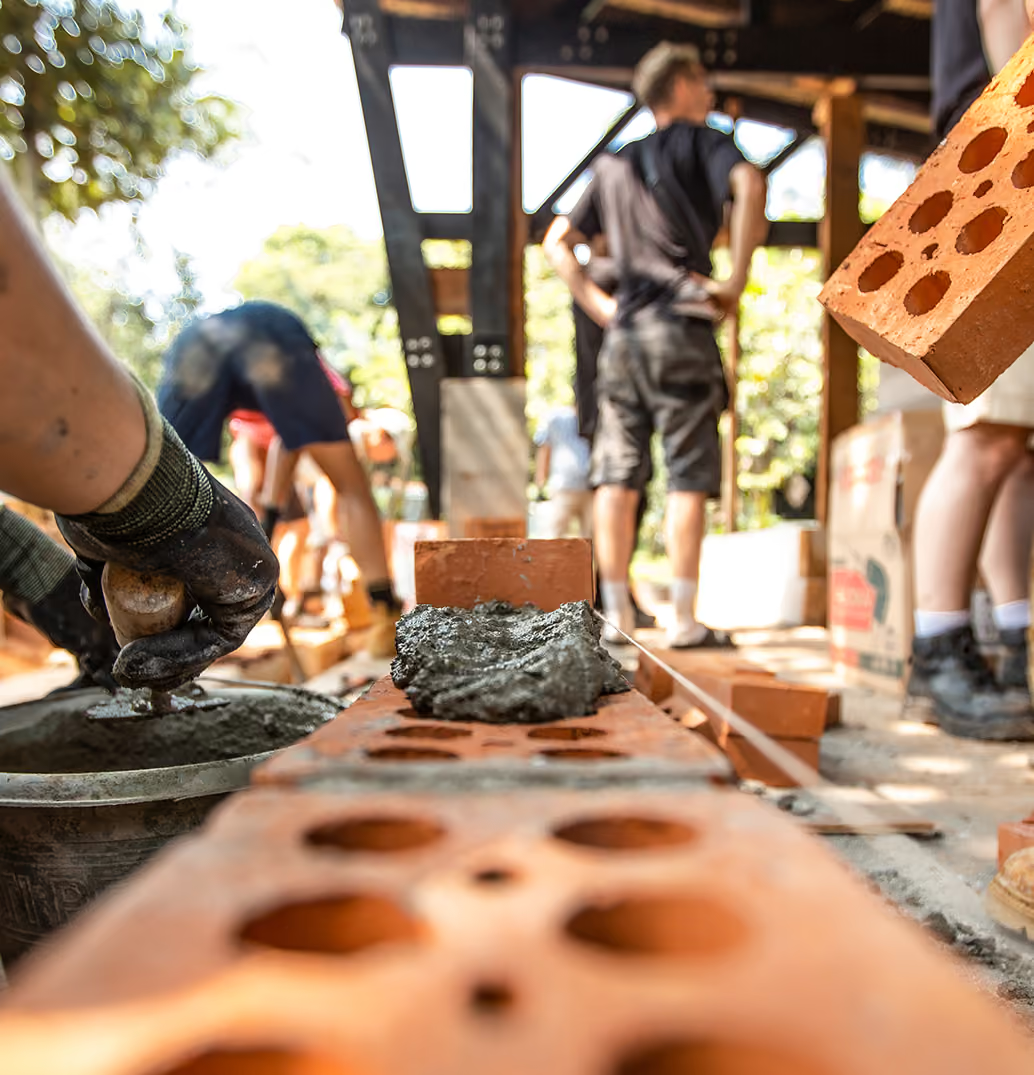
Every participant who joins a CAUKIN build, most of whom have never set foot on a construction site before, goes through tool inductions before they pick up a saw or a trowel. Getting this right matters more here than on a typical UK site. CAUKIN's teams are made up of participants with all skill levels, so making sure everyone understands the tools and the risks before they start is fundamental to keeping the build safe.
Daily Site Activities and the Leader of the Day
CAUKIN has built a distinctive system around innDex's daily site activity reporting. Each day, one participant is appointed "leader of the day", responsible for keeping the build on track, coordinating the team, and completing that day's site reporting. They speak to the previous day's leader to understand what happened, log the day's activities, and hand everything over to the next person in turn.
"Having a professional level application and a portal to use really gives the participants this heightened ownership," he says, "and also gives them a lot of pride in what they're doing, because they're using a legitimate, industry standard application that they can really get into and enjoy using. It makes them feel professional." - Harry Thorpe, Co-founder of CAUKIN Studio.
Close Calls and Accident Reports
Working with inexperienced participants in unpredictable environments throws up safety scenarios that would be almost unheard of on a UK site. Harry recalls one particular close call from a Zambia project, when an elderly man from the village wandered onto site with his bicycle and ten live chickens, hoping to sell them, while the team was digging foundations and pouring concrete nearby.
Recording incidents like this properly, rather than letting them disappear along with the paperwork, means CAUKIN can build year on year.
"Now that we've used innDex for a few years, we can start to build each year on how we used it last year, what did work, what didn't work". - Harrison Marshall, Co-founder of CAUKIN Studio.
Close calls logged one year directly inform the health and safety briefing for the next, both for participants and for the local workers who join the build, whose PPE and site safety standards CAUKIN also has to manage closely.
CAUKIN also extends this reporting beyond physical safety. Teams are split into on-site and pastoral leaders, and any welfare or mental health concerns raised by the pastoral team are captured through the same system, giving directors a fuller picture of how a project, and its people, are really doing.
Progress Photos
For a business run remotely, with three directors based in the UK overseeing sites thousands of miles away, progress photos have become one of the most valuable tools in the kit. Written updates only tell half the story. Harry gives a telling example: a team might report that they've dug all their foundation pads for the day, but the photographs tell a different story, pads full of water, a sign they've hit the water table and need to change their approach. "It's that level of visual detail that allows us remotely to still have a bit of control, but also be able to give real support," he says, "not just come up with ideas that maybe aren’t applicable."
Before innDex, that kind of visual update would come through a WhatsApp channel or similar messaging app, fine for a single project, but with seven live sites running at once across Fiji, the Philippines, Rwanda, Indonesia and the UK, communications spread across different chats and channels quickly become difficult to keep straight. Photos, updates and reports for one project can easily get lost among or confused with another. Having everything logged against the right project in one place gives CAUKIN's directors a structured, reliable record for each site, rather than trying to piece together scattered messages from memory.
For participants arriving partway through a build, being able to scroll back through the historical information, from a blank site and holes in the ground to a finished building, gives them confidence in what they're contributing to.
LOOKING AHEAD.
We’re proud to continue supporting CAUKIN with their projects. It's a partnership built on a shared vision of empowering people while bringing construction excellence worldwide. Next on the list is bringing daily briefings onto the platform, so planned targets can be checked against what's actually achieved and future builds scheduled with even more precision.