.svg)




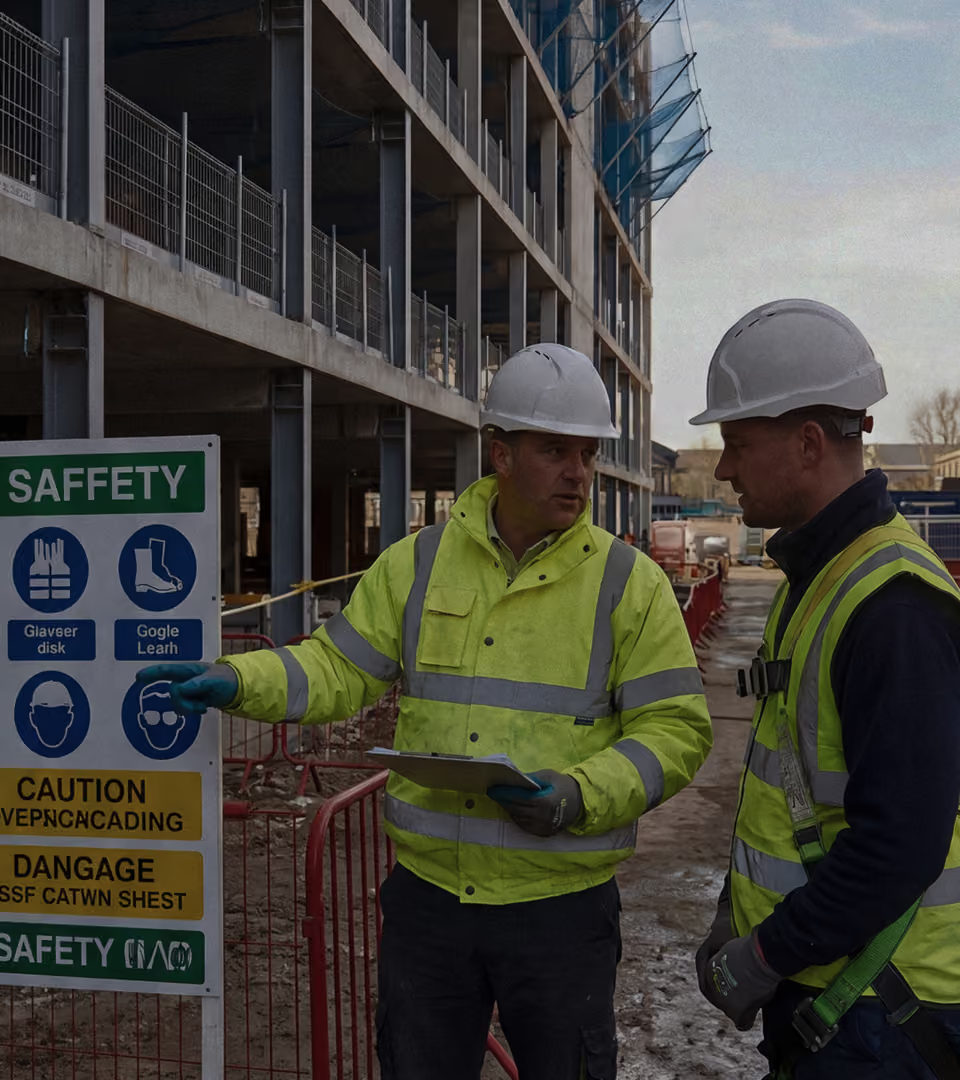
Construction doesn't stop for paperwork. But health and safety legislation shapes almost everything that happens on site before a single brick is laid. It decides who's accountable for what, what gets recorded and signed off, and what happens when something goes wrong. It's the reason inductions happen, permits get issued, and certain jobs stop until a second person signs them off.
This blog covers the essential regulations and legislation in construction and why they matter, that you can use as a reference for compliance.
The Umbrella Act: Health and Safety at Work etc. Act 1974 (HSWA).
Everything else sits underneath this one. The HSWA places a general duty on employers to ensure, so far as is reasonably practicable, the health, safety and welfare of employees and anyone else affected by their work: visitors, the public, other contractors on site.
It's deliberately broad, the legal foundation every other health and safety construction regulation builds on. It's also why employers with five or more staff need a written health and safety policy: that's Section 2(3) at work.
Construction (Design and Management) Regulations 2015 (CDM 2015).
CDM 2015 is construction's own rulebook. It applies to every project, from a domestic extension to a multi-billion-pound infrastructure scheme and sets out who's responsible for what through defined duty-holder roles: client, principal designer, principal contractor, designers, and contractors.
It also requires:
- Pre-construction information: safety information passed to the team before work starts
- The construction phase plan: how the work gets managed safely on site
- The health and safety file: a record for future maintenance and alterations
- Welfare provisions: the baseline standard for site facilities
The headline message: safety is a planning problem as much as a site one. Decisions made before anyone's on site still carry legal weight.
Management of Health and Safety at Work Regulations 1999.
This is where risk assessment stops being good practice and becomes a legal requirement. Employers must carry out a "suitable and sufficient" risk assessment of the risks to their people and record the findings if they have five or more employees.
It also requires employers to appoint competent people, train and inform their teams, and apply the hierarchy of control: eliminate a risk before you just control it.
This is the regulation behind most of the risk assessment paperwork on site: RAMS, task-specific assessments, and the thinking behind them.
Work at Height Regulations 2005
Falls from height are one of construction's leading causes of fatal injury, and this regulation reflects that. It applies to any work at height where a fall could cause injury, with no minimum height threshold. A low platform counts as much as a roof.
In practice, working at height is rarely something you can avoid, most jobs need it. So it comes down to planning properly: briefing everyone involved, assessing every risk as conditions change, and making sure the people carrying out the work are competent and hold the right permits.
That hierarchy is why edge protection, guardrails, harness systems, and sign-off processes exist.
Control of Substances Hazardous to Health Regulations 2002 (COSHH).
COSHH governs exposure to hazardous substances on site: dusts (including silica), chemicals, fumes, and biological agents. Employers must assess the risk and apply the hierarchy of control: eliminate, substitute, control at source, and only then reach for PPE.
The harm here is often cumulative, not immediate: respiratory disease, occupational asthma, and conditions built up over years of low-level exposure. That's why assessment and control matter as much as the response.
Provision and Use of Work Equipment Regulations 1998 (PUWER).
PUWER covers the equipment and plant on site, from hand tools to major machinery. Equipment must be suitable for the job, maintained, inspected, and used only by people trained and competent to use it.
It's the regulation behind inspection regimes and the records proving a piece of plant was fit for use on the day, not just at its last service.
Reporting of Injuries, Diseases and Dangerous Occurrences Regulations 2013 (RIDDOR).
RIDDOR requires the "responsible person" (usually an employer or whoever controls the premises) to report certain events to the HSE: specified injuries, over-seven-day injuries, occupational diseases, deaths, and dangerous occurrences serious enough to have caused harm.
This is where a digital incident record earns its keep. innDex's Accidents & Incidents tool logs events in real time from the site, with structured investigation and full audit trails. So the evidence for RIDDOR reporting is already there, not reconstructed from memory.
Personal Protective Equipment at Work Regulations 1992 (as amended 2022).
PPE is the last line of defence, not the first. Employers must provide suitable PPE free of charge wherever risks can't be controlled another way, and keep it maintained, stored, and actually used.
The 2022 amendment extended these duties to limb (b) workers, a wider group than just direct employees.
Other Construction Site Health and Safety Regulations Worth Knowing.
Other health and safety laws in construction that may apply, depending on the work:
- Control of Asbestos Regulations 2012: for any work involving or disturbing asbestos-containing materials
- Lifting Operations and Lifting Equipment Regulations 1998 (LOLER): for cranes, hoists, and other lifting equipment
- Control of Noise at Work Regulations 2005: for exposure to harmful noise levels
- Control of Vibration at Work Regulations 2005: for hand-arm and whole-body vibration exposure
Each applies only where the relevant hazard is present on a given project.
The Bigger Picture: Why Health and Safety Regulations in Construction Matter Day to Day.
None of this sits in isolation. One task, say working at height near hazardous dust with powered equipment, can trigger Work at Height, COSHH, and PUWER all at once, sitting beneath the general duty in the HSWA and the risk assessment requirement in the 1999 Regulations. Broad duties at the top, specific requirements underneath, all pointing to the same goal: people go home safe.
Acknowledging construction health and safety legislation isn't just a compliance exercise. It's the framework behind daily decisions on every site, for every trade, on every project.
Where innDex Fits In.
Understanding the regulations is the first step. Actually demonstrating compliance, day in and day out, across every trade and every site, is where most of the real work happens.
That's the gap innDex was built to close.
Instead of chasing paper records or hoping the right RAMS document is in the site cabin when an inspector asks for it, innDex gives you a digital audit trail that's there the moment you need it. Inductions, competency checks, toolbox talks, risk assessments. All logged, all timestamped, all accessible from a phone on site or a desk in the office.
If you'd like to see how it works in practice, speak with us now.