.svg)





BUILDING INSIDE A LIVING LANDMARK
That project is the repositioning of One and Two UN Plaza, two towers at the United Nations Development Corporation. It's currently the largest job the New York interiors group has , by both volume and duration, with construction underway since 2023 and completion trending toward 2029. Turner was formally awarded the full scope in March 2025.
The work spans roughly ten phases at once. Turner is gutting entire office floors and handing back white box space for tenants to restack, upgrading facades with cleaning and gasket repairs across both buildings, and carrying out heavy central plant infrastructure work, replacing chillers, cooling towers and generators to give the buildings a more efficient, more sustainable future. A core Turner team of around twelve runs the whole operation, directing an average of 80 to 90 trade partners on site each day.
The catch is that both towers are fully occupied. There are offices throughout, and the Millennium Hilton sits at the top of both buildings, so there are guests sleeping, showering and checking in while major systems are switched on and offline below them. "We don't have the luxury of an empty skeleton where we can just swing hammers whenever we want," Abby explains. Every phase has to be sequenced around live operations, and with limited elevators serving both worker movement and the building's day-to-day, vertical transportation became one of the hardest logistical puzzles on the job.
Then there's the union dimension. The project runs under a Project Labor Agreement, meaning nearly 100% of Turner's workforce is unionionised. That makes a dedicated entrance and exit for Turner's people non-negotiable. Add the security expectations of a UN site, daily rosters of exactly who is in the building, plus the ability to account for every person in an evacuation, and the picture is clear: knowing who is on site, where, and when, is not a nice-to-have here. It's a necessity.
PAPER BADGES, PAPER TRAILS
Before implementing innDex, there wasn't a reliable way to answer those questions. In the early abatement and demolition phase, workers came in through the loading dock and were handed a printed paper badge. "It got them in the building once, and then they left however they left," Abby says. "There really wasn't a way of tracking who, what, when, where."
Orientations followed a similar pattern. A new worker would sit in a room, go through a PowerPoint, and then be asked to sign a form that was then filed away. The process wasn't consistent, and crucially it wasn't quantifiable. You couldn't track it, and you couldn't flag when a worker's Site Safety Training (SST) card had expired. All of that responsibility landed on the field team, the same people whose actual job is putting work safely in place.
"You're just trying to build a job. You have to remember to build it safely," Abby says. "And oh, by the way, did you check that carpenter's SST card that expired two weeks ago? That responsibility lies on us out here on the field."
The pain often showed up long after the fact. When an incident gets investigated, sometimes years later, the request is always the same: show me this specific worker's orientation. "On previous projects, it was always chasing our tail trying to find that piece of paper for that one guy," she recalls. The records existed somewhere, but somewhere isn't good enough.
FINDING A PARTNER, NOT JUST A PLATFORM
Abby first met innDex co-founders Aaron and George at Procore Groundbreak, where innDex were there as a Procore integration partner. The timing was lucky. It came early enough that Turner hadn't yet locked in its logistics for the dedicated entrance, so there was room to do things properly from the start.
What sold her wasn't a feature list, it was the prospect of getting a genuine headache off her team's plate. A system that could track competencies, flag expiries automatically and even stop a worker entering the building when their SST lapsed was, in her words, "a game changer." It meant her team would no longer burn days reconstructing records after something had gone wrong. (The recommendation originally came from a Turner colleague in New Jersey who had used innDex with real success on an earlier project.)
ORIENTATIONS THAT HAPPEN BEFORE WORKERS ARRIVE
Today, every worker completes their orientation digitally through innDex before they get access to the job, including Turner's hour-long safety video and the certificate that goes with it. The detail that used to live in a PowerPoint and a paper form now lives in a structured, trackable flow, asking for the same confirmations and sign-offs, but in a format that can actually be searched and proven.
Orientations on innDex have also kept people engaged. "The digital process, paired with the promise of faster access, gives workers a reason to pay attention.”
Turner leaned into adoption rather than leaving it to chance. Alan Okechukwu, Assistant Engineer became the site champion, guiding workers through the steps, helped along by posters with QR codes that walk people through scanning in, completing their details and watching the safety video. For a generation of trade workers who didn't grow up with smartphones, that hands-on support has made all the difference. "It takes patience," Abby says, "but they're always reminded it's worth it when it gets them in and out quicker."
COMPETENCY YOU CAN COUNT ON
The SST card is a New York specific competency requirement, and being able to treat it as mandatory inside innDex matters enormously. Because the platform is configurable, those rules can be set to match whatever a given state or city demands, so a requirement that's essential in New York can be swapped for the equivalent elsewhere. On this project, innDex flags cards as they approach expiry, surfaces mismatches against a worker's government ID, and automatically blocks anyone whose SST has lapsed from accessing the site. The same logic covers the Turner safety certificate.
What used to be a silent risk, a card quietly expiring with nobody watching until a Department of Buildings inspector asked the wrong question, is now caught by the system before it becomes a violation, and violations can result in hefty fines. Once a worker has completed orientation, Turner confirms their details, issues a physical hard hat sticker and logs its number against the worker's profile in innDex, then approves the orientation and activates their access. It's a distinctly Turner process, and the platform was configured to hold it.
FACES, NOT BADGES
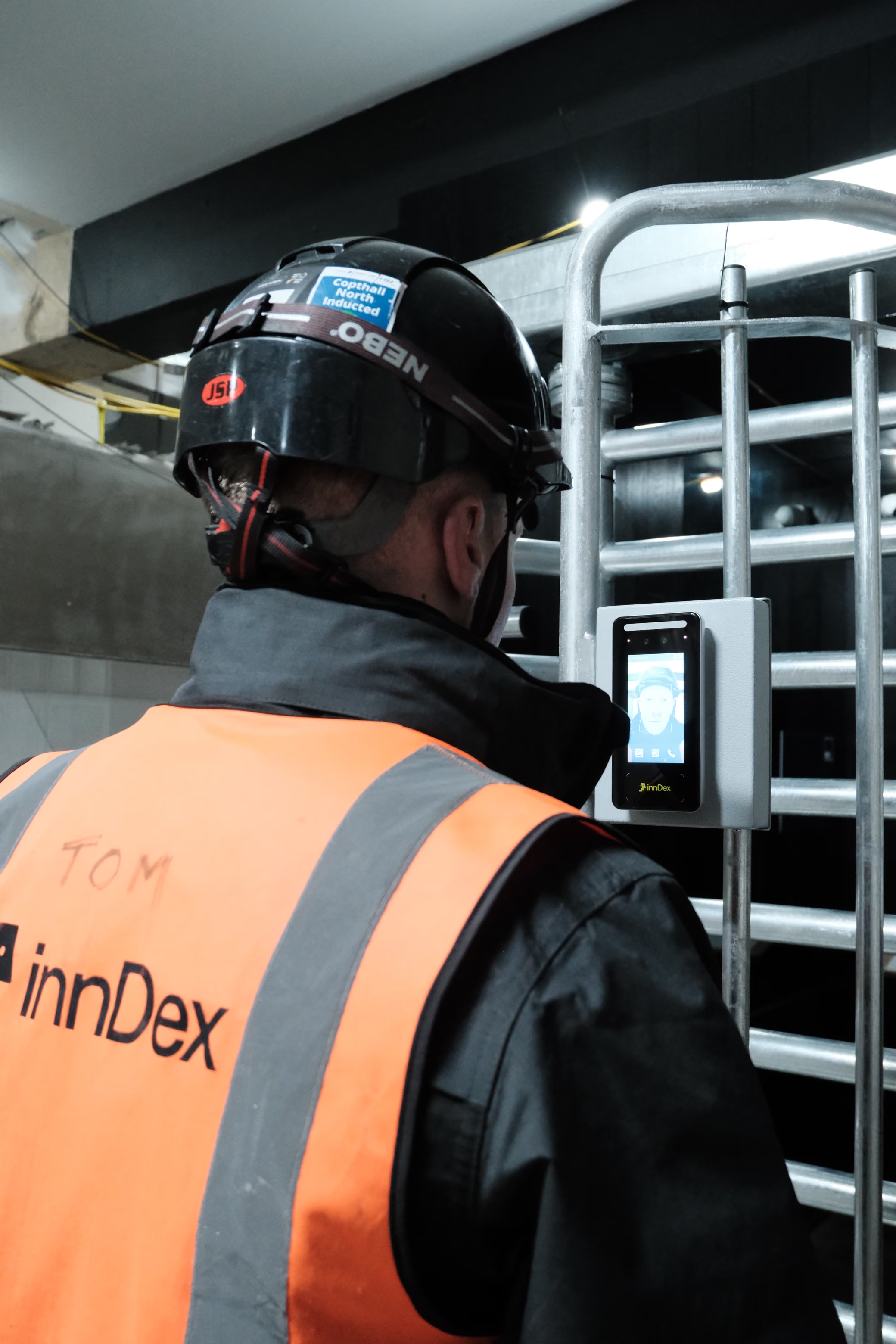
The dedicated union entrance is now controlled by turnstiles, and Turner chose facial recognition to manage them. That wasn't the obvious call at first. The team was hesitant, and for a while talked themselves toward simply printing badges with workers' faces on them.
The problem with badges, Abby quickly realized, is "anyone can toss a badge to someone else, scan, and get through a turnstile. That's just not the right way." Then there's the endless admin of lost badges, forgotten badges, and workers who get a badge after a week and never return. On past projects, that approach was "impossible to track."
The concerns about facial recognition were practical: lighting, the odd glitch, a worker who shaves his beard the morning he arrives. Turner, together with innDex worked through every one of them, relocating a turnstile, adding a light fixture, and having anyone with issues pre-scan their face on the app. The verdict now is unequivocal. "The facial recognition has been the best thing we've done," Abby says. Workers get in faster, with no wallet and no fumbling, which means less pushback from the people who have to use it every single day.
REAL-TIME VISIBILITY, REAL DECISIONS
With access control feeding the innDex platform, Turner finally has the live picture the project demands. The turnstile data underpins the daily manpower count and helps the team validate their state required workforce diversity reporting, confirming the makeup of trade partners on site against strict project requirements. Leadership can see at a glance how many supervisors, how many first aiders and how many workers are in the building at any moment. "Having those metrics at our fingertips has been really helpful," Abby says.
It also gives the team a way to ask sharper questions. If a company is consistently short on output, the data shows whether it's a manpower problem or a "they're leaving at 11am" problem. And for a UN site that hands security a daily roster and needs total accountability in an evacuation, knowing exactly who has come and gone is mission critical.
ONE MESSAGE, EVERY WORKER
Site messaging has become Turner's direct line to the workforce, which matters when you don't hold email addresses for trade partners. It carries safety stand down notifications, including Turner's annual Safety Week and monthly stand downs. It's how the team tells everyone to stay home and stay safe when a blizzard shuts the city down, something they've had to do twice on this job. And it handles the genuinely unusual demands of a UN campus, from the two-week shutdown during the General Assembly to short-notice loading dock closures when a dignitary is on the move.
"The messaging has been great because it is sent to everybody, and you can see who's opened it," Abby says. The people who actually need to know that the gate is closing for an hour are the ones who get told.
A TEAM IN YOUR CORNER
Abby singles out innDex implementation manager Jacob Byrne, who has worked alongside her since long before the site ramped up to 90-plus workers a day, for being consistently available and ready to troubleshoot for individual workers and the wider team alike.
"There's never been a moment where we thought, where is innDex to help us," she says. "You've been with us every step of the way. That's a huge reason it continues to be successful. Otherwise we'd have abandoned it a long time ago."
THE BOTTOM LINE, AND WHAT'S NEXT
The clearest measure of impact is time. Running orientations the old way locked a superintendent away from building the job for at least an hour every day, plus another half hour scanning and filing documents. Add the effort of physically tracking every worker on site, and Abby puts the daily saving at 90 minutes to two hours, time handed straight back to the people Turner needs out on the floor.
The appetite stretches well beyond this one job. With three new Turner towers rising in Manhattan and data center projects on the books, Abby sees a clear role for innDex across the way Turner runs sites in New York, removing the reliance on printed badges and third-party security booths, and giving safety teams a resource rather than another responsibility.
For now, on one of the most demanding sites in the city, innDex gives Turner something that paper never could: the confidence to say exactly who is on site, who is competent to be there, and where they are, at any moment.